
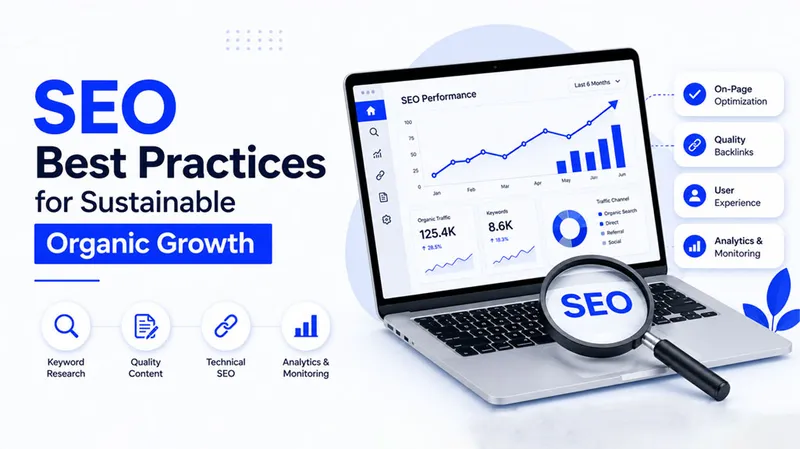
Organic traffic is the rare marketing channel that compounds. Paid advertising stops the moment the budget does, but a well-ranked page can keep bringing in visitors for years after it is published, at close to zero marginal cost.
That is the appeal, and it is why every business owner, in-house marketer, and SEO consultant in India is chasing the same thing: rankings that last. The catch is in the first word of "sustainable organic growth", because anything built on shortcuts tends to unravel at the next algorithm update.
This guide sets out the practices that still hold up in 2026: the technical groundwork, the content approach, the way authority is genuinely earned, and how to tell whether any of it is working. None of it is a trick. All of it is built to last.
What sustainable growth actually means
Sustainable organic growth is traffic that survives algorithm updates and does not depend on tactics you would be uncomfortable explaining to Google.
It has three properties worth naming. It compounds, because each quality page adds to a library that keeps working long after publication. It is defensible, because it rests on real usefulness rather than a loophole. And it is judged on business outcomes, not on charts that flatter without paying the bills.
Hold those three in mind. Every practice below serves at least one of them.
Start with technical foundations
Content cannot rank if search engines cannot reach it, read it, or trust the experience of using your site. Technical SEO is the floor that everything else stands on.
Crawlability and indexing
Before anything clever, confirm the basics. Search engines need to find your pages, and you need to know they have.
- Keep a clean XML sitemap and submit it in Google Search Console.
- Check that important pages are not blocked by robots.txt or a stray noindex tag.
- Fix crawl errors and broken internal links as they appear, not once a year.
- Resolve duplicate content with canonical tags so ranking signals are not split across URLs.
These are not growth tactics in themselves. They are the reason growth tactics work at all.
A useful habit is to check the Pages report in Search Console once a month. If pages you care about are marked as excluded or not indexed, that is a problem to solve before you write another word, because an unindexed page earns nothing no matter how good it is.
Core Web Vitals and page experience
Google measures the real-world experience of your pages through Core Web Vitals, and the thresholds are published in its Search Central documentation rather than left to guesswork.
A good experience means Largest Contentful Paint under 2.5 seconds, Interaction to Next Paint under 200 milliseconds, and Cumulative Layout Shift below 0.1, measured on real visitors at the 75th percentile. Pages that clear those bars feel fast and stable to the person using them.
Speed is not only a ranking factor. It is a conversion factor. A visitor who leaves before the page loads never reads the content you worked so hard on.
Site architecture and internal linking
A logical structure helps both people and crawlers understand what matters on your site.
Keep important pages within a few clicks of the homepage. Group related content into clear sections. Link between related pages using descriptive anchor text, so authority flows to the pages you most want to rank. A flat, tidy architecture beats a deep, tangled one every time.
Internal links are the most underused tool in most SEO programs. They cost nothing, they are entirely within your control, and they tell search engines which of your pages you consider most important. When you publish something new, add links to it from the older pages it relates to, rather than leaving it stranded.
Build content around intent, not keywords
Keyword lists tell you what people type. Intent tells you why they typed it. Content that lasts answers the why.
Match the four intent types
Almost every query sits behind one of four goals, and getting this right is most of the battle.
- Informational: the person wants to learn something.
- Navigational: they are looking for a specific site or brand.
- Commercial: they are comparing options before they buy.
- Transactional: they are ready to act now.
A page that tries to sell when the searcher wanted to learn will lose, however well optimized it is. Read the results already ranking for a term and you will see the intent Google has decided to reward.
A quick worked example
Take the query "best running shoes for flat feet". The intent is commercial: the person is comparing, not yet buying. The pages that win are detailed comparisons, not a single product page with a buy button. Serve the comparison, earn the trust, and the sale tends to follow later.
Depth over volume
Publishing more pages is not a strategy. Publishing the right pages, done properly, is.
One thorough page that fully answers a question will usually outperform five thin ones that circle around it. Depth signals genuine knowledge, keeps readers on the page, and gives other sites a reason to link. Cover the follow-up questions a curious reader would ask next, in the same place, and you remove their reason to go elsewhere.
This is also the most reliable defense against thin, machine-generated competition. Anyone can now produce a passable surface-level article in seconds, so surface-level content is worth less than ever. First-hand experience, specific numbers, and a point of view are the things that cannot be mass-produced, and they are exactly what earns rankings and citations.
On-page optimization that still counts
With intent settled, a handful of on-page basics help each page communicate clearly. None are tricks. All are hygiene.
- Write a title tag that states the value plainly and reads naturally to a human.
- Use one clear H1, then a logical heading order beneath it so the structure is obvious.
- Add a meta description that earns the click, even though it is not itself a ranking factor.
- Give images descriptive alt text, for accessibility first and search second.
- Use structured data where it fits, so eligible pages can qualify for rich results.
Do these once, properly, and move on. They are a checklist, not a career.
Earn authority the durable way
Authority is what separates a page that ranks from one that merely exists. It is also where most shortcuts live, and where they do the most damage.
Treat links as a byproduct
Backlinks still matter, but the way you earn them decides whether they help you or sink you.
Links earned because something is genuinely worth citing are durable. Links bought or spammed are a liability that a future update can turn into a penalty. The sustainable route is slower and duller: publish original research, a useful tool, or a genuinely better explanation, then earn mentions over time. Chasing links directly is the fast road that ends at a cliff.
Show real experience and expertise
Google’s own guidance rewards content that demonstrates first-hand experience and genuine expertise, especially on topics that affect a reader’s money or health.
Put a real author behind your content. Show credentials where they matter. Include original detail, data, or examples that only someone who has actually done the work would know. Generic content assembled from the current top ten results has nothing to set it apart, and search engines keep getting better at noticing.
Measure what actually matters
If you cannot measure it, you cannot improve it, and you certainly cannot defend the budget. Yet most SEO reporting tracks the wrong things.
Separate leading from lagging indicators
Some numbers tell you what already happened. Others hint at what is coming.
- Lagging indicators: organic sessions, keyword rankings, and conversions from organic. Real, but slow to move.
- Leading indicators: pages indexed, impressions in Search Console, and new keywords a page starts to appear for. Early signs that the effort is landing.
Watch the leading indicators week to week and the lagging ones month to month. Judging a young campaign only on conversions is like digging up a seed each morning to check for a tree.
Use Search Console as ground truth
Third-party tools estimate. Google Search Console measures. For anything happening on Google’s own surfaces, treat its data as the source of truth and everything else as an approximation. Impressions, average position, and click-through rate per query show you where you are close to winning, and where a small push would pay off.
The AI search shift
The ground is moving, and any honest guide has to say so. Google’s AI Overviews, along with assistants such as ChatGPT and Perplexity, increasingly answer questions directly, with the source pages cited beside the answer.
The reassuring part is that the fundamentals still apply. These systems retrieve from the same index and favor content that is clear, well-structured, and genuinely useful. Original insight and clean technical foundations, the same things that always mattered, are what get a page quoted rather than skipped.
The change is in expectation, not method. Fewer visits will come from simple lookups, so the visits you do earn should come from people with real intent, landing on pages built to convert them.
There is a practical takeaway here. Write pages that answer a clear question directly, near the top, in plain language, and then support that answer with the depth a serious reader wants. Content structured that way is easy for a person to scan, easy for a search engine to rank, and easy for an AI system to quote. The same page serves all three.
Do it yourself, or bring in help
Every practice here is learnable. The real constraint is usually time.
Running SEO in-house works well when the site is small and someone can give it steady, informed attention. As the site and the stakes grow, the work becomes a job in itself: technical fixes, content production, and measurement all at once.
Hiring a specialist in the West can run into a serious monthly salary before a single page is produced, which is why many growing businesses instead work with a dedicated offshore team, and get a group of specialists for the cost of one local hire.
Whichever route you choose, ask the same four questions of anyone you trust with the work.
- Which of your recommendations come from Google’s documentation, and which are your own hypotheses?
- What will you report each month, and why those particular numbers?
- What does month one look like if rankings do not move immediately?
- Who owns the accounts and the data if we ever part ways?
Anyone who cannot answer those four is selling activity, not results.
A realistic timeline
SEO is often sold as fast. It is durable, which is not the same thing. Set the expectation honestly and the results look like success rather than disappointment.
- Months one to three: technical fixes, keyword and intent mapping, and the first content published. Expect movement on long-tail terms, not headline keywords.
- Months four to six: the content library grows, early authority builds, and traffic begins to compound.
- Months seven to twelve: rankings mature on competitive terms, and the compounding finally becomes visible in the numbers.
If a provider promises page one in thirty days, they are describing paid ads or luck, not organic growth.
Mistakes that quietly stall growth
Most stalled campaigns share the same avoidable errors. Watch for these.
- Chasing algorithm rumors instead of shipping useful content.
- Publishing thin pages at volume to hit a quota.
- Ignoring technical debt until it buries otherwise good content.
- Buying links and hoping the next update looks the other way.
- Reporting vanity metrics while conversions stay flat.
- Giving up around month three, right before the compounding begins.
The bottom line
Sustainable organic growth is not a secret and it is not a shortcut. It is a technically sound site, content built around what people actually want, authority earned rather than bought, and honest measurement of what moves the business.
That formula is slower than the tactics promising overnight results. It is also still standing when those tactics collapse. Build for the long term, and organic search becomes the channel that quietly pays for itself, year after year.
Frequently asked questions
How long before SEO shows results?
For most competitive terms, expect three to six months before meaningful movement, and up to a year for the compounding to show clearly. Long-tail terms can move faster. Anyone promising page one in weeks is describing something other than organic growth.
Is SEO still worth it now that AI answers appear in search?
Yes. AI answers still cite sources, and they retrieve from the same index that ranks pages. Clear, useful, well-structured content is what gets quoted. The fundamentals hold; only the format of the results has shifted.
How many blog posts should I publish each month?
There is no magic number, and volume for its own sake tends to backfire. One genuinely thorough, well-researched page beats several thin ones. Consistency and quality matter far more than raw output.
Do I need to hire an agency, or can I do this myself?
Small sites can be handled in-house with steady attention. As the work grows, many businesses bring in a specialist or an offshore team for the range of skills required. The deciding factor is usually available time, not ability.